Business Idea vs. Business Model Comparison Sheet
A business idea is easy to say.
“I want to start a cleaning business.”
“I want to do lawn care.”
“I want to make money with pressure washing.”
“I want to use AI to help local businesses.”
Those may be real opportunities. But by themselves, they are not business models.
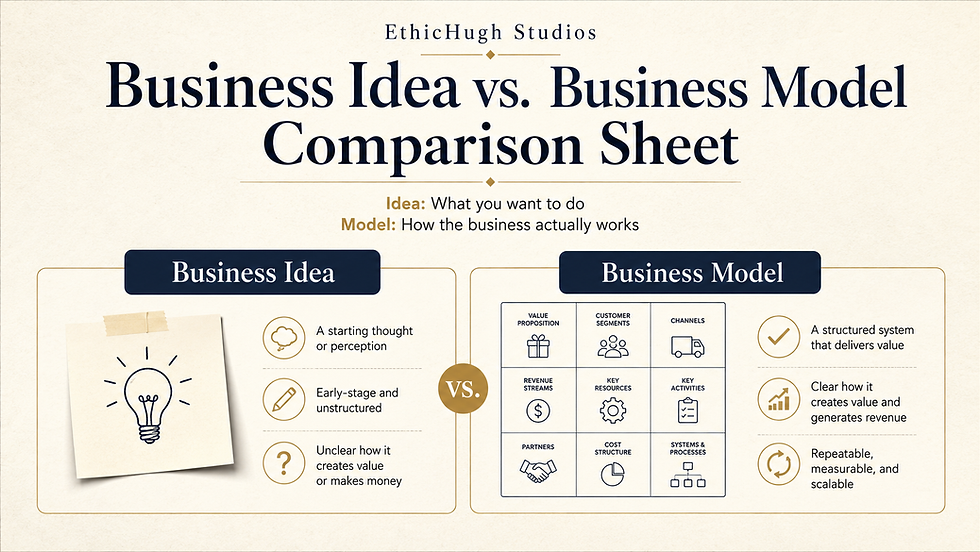
A business idea is what you want to do. A business model is how the business actually works.
For a deeper explanation of this core idea, read A Business Idea Is Not a Business Model.
This business idea vs business model comparison is meant to help beginners see the difference before they spend money, buy equipment, or announce a new business.
That difference matters because many beginners do not fail because they picked a terrible idea. They fail because they never turned the idea into a clear working model.
They buy equipment before they understand the customer.
They create a logo before they define the offer.
They post online before they know what problem they solve.
They lower prices before they understand the workflow.
They get excited about “starting a business” before they know what the business actually needs to repeat.
That is why this comparison sheet exists.
Use it before you spend money, announce the idea, buy tools, build a website, or chase your first customer.
The goal is not to make the idea sound exciting. The goal is to find out whether it can become a real business model.
Business Idea vs Business Model: Quick Comparison
A business idea answers:
“What could I do?”
A business model answers:
“How would this actually work?”
A business idea is the starting point.
A business model is the structure.
A business idea can be vague.
A business model needs to be specific.
A business idea may sound good.
A business model has to survive contact with real customers.
The Basic Difference
Business Idea
A business idea is the general thing you want to offer.
Examples:
· House cleaning
· Lawn care
· Mobile car detailing
· Pressure washing
· Junk removal
· AI automation service
· Virtual assistant service
Business Model
A business model explains how the idea becomes a working business.
It answers:
· Who is the customer?
· What exact problem are you solving?
· What service or product are you offering?
· How will you price it?
· How will the work be delivered?
· How will customers know what to expect?
· How will the business get repeat customers or referrals?
Simple test:
If you can describe it in one sentence, it may be an idea.
If you can explain how it finds customers, delivers value, gets paid, and repeats, it is starting to become a model.
Customer
Business Idea Question
Who might want this?
Business Model Question
Who is the specific customer this business is built to serve?
A beginner might say:
“Everyone needs house cleaning.”
That is an idea-level answer.
A stronger business model answer would be:
“Busy working families who need recurring biweekly standard cleaning.”
Or:
“Move-out cleaning for renters, landlords, and property managers.”
Or:
“Senior homeowners who need light, dependable home help with clear expectations.”
The clearer the customer, the easier it becomes to shape the offer.
Problem
Business Idea Question
What service sounds useful?
Business Model Question
What specific problem does the customer need solved?
Customers do not usually buy “a business idea.”
They buy relief from a problem.
They want the house clean before guests arrive.
They want the lawn handled before the city notice comes.
They want the driveway cleaned before selling the home.
They want the car detailed because the interior has become embarrassing.
They want someone dependable because they are tired of unreliable service providers.
The business model starts getting stronger when the problem becomes specific.
Offer
Business Idea Question
What could I sell?
Business Model Question
What exact starter offer can I explain clearly?
A weak offer sounds like:
“I do cleaning.”
A stronger starter offer sounds like:
“Standard recurring house cleaning for kitchens, bathrooms, floors, dusting, and surface cleaning.”
A weak offer sounds like:
“I do lawn care.”
A stronger starter offer sounds like:
“Weekly or biweekly mowing, edging, blowing, and basic lawn cleanup for residential yards.”
A weak offer sounds like:
“I help with AI.”
A stronger starter offer sounds like:
“I help local businesses set up simple AI-assisted customer reply templates, content calendars, and workflow checklists.”
A clear offer helps the customer understand what they are buying.
It also helps the beginner avoid overpromising.
Pricing
Business Idea Question
How much could I charge?
Business Model Question
What pricing method fits the work, the customer, and the time required?
Pricing is not just a number.
Pricing has to reflect:
· Time
· Travel
· Materials
· Difficulty
· Scope
· Customer expectations
· Repeat potential
· Mistake risk
A beginner often asks:
“What should I charge?”
A better question is:
“What factors should affect the price, and how do I explain those factors clearly?”
A real business model needs pricing logic, not just a random number.
Workflow
Business Idea Question
Can I do the work?
Business Model Question
Can I repeat the work in a clear, reliable way?
Doing one job is not the same as building a business.
A workflow includes:
· How the customer contacts you
· How you ask questions
· How you estimate the job
· How you confirm the scope
· How you prepare
· How you perform the work
· How you collect payment
· How you follow up
· How you ask for reviews or referrals
The work is visible. The workflow is what makes the business manageable.
Expectations
Business Idea Question
Will people like this service?
Business Model Question
What does the customer need to understand before the work begins?
Expectation problems destroy beginner businesses.
Customers need to know:
· What is included
· What is not included
· How long the job may take
· What they need to do before you arrive
· What results are realistic
· What costs extra
· How communication works
· When payment is due
A beginner business becomes more professional when expectations are clear before the work starts.
Repeat System
Business Idea Question
Can I get a customer?
Business Model Question
Can this business create repeat customers, referrals, reviews, or follow-up opportunities?
A one-time job can produce money.
A repeat system helps build a business.
Repeat systems can include:
· Recurring cleaning schedules
· Weekly or biweekly lawn care
· Seasonal pressure washing reminders
· Detailing maintenance packages
· Referral requests
· Review requests
· Follow-up messages
· Simple email or text reminders
A business model gets stronger when the first customer can lead to the next customer.
The Comparison Sheet
Use these questions before choosing a business idea.
Business Idea
· What do I want to do?
· Who might want it?
· What service sounds interesting?
· What tools might I need?
· What could I charge?
· Can I do the work?
· Can I get someone to buy it?
Business Model
· Who is the specific customer?
· What problem am I solving?
· What exact starter offer will I make?
· How will I price it logically?
· What workflow will I follow?
· What expectations must be clear?
· How will I get repeat customers, referrals, or reviews?
Beginner-Friendly Test
Before you move forward, ask yourself these seven questions:
· Can I name the specific customer?
· Can I describe the problem in plain language?
· Can I explain my starter offer clearly?
· Can I explain what affects the price?
· Can I describe the basic workflow from first contact to follow-up?
· Can I tell the customer what is included and what is not included?
· Can I create a simple path toward repeat work, reviews, or referrals?
If the answer is mostly yes, your idea is becoming a business model.
If the answer is mostly no, the idea may still be useful, but it needs more structure before you build around it.
You can also use the Beginner Business Model Checklist as a quick follow-up tool before choosing your next step.
Example: House Cleaning
Idea-level thinking:
“I want to start a house cleaning business.”
Business-model thinking:
“I will offer standard recurring house cleaning for busy homeowners who want dependable weekly or biweekly cleaning. The starter offer will focus on kitchens, bathrooms, floors, dusting, and surfaces. Deep cleaning, inside appliances, windows, and heavy organizing will be separate. I will use a clear checklist, confirm scope before each job, and follow up after service to encourage reviews and repeat scheduling.”
That is no longer just an idea.
That is the beginning of a model.
Example: Lawn Care
Idea-level thinking:
“I want to start a lawn care business.”
Business-model thinking:
“I will offer residential mowing, edging, blowing, and basic lawn cleanup for homeowners who want dependable weekly or biweekly service. I will define yard size, access, obstacles, grass height, and cleanup expectations before pricing. I will build recurring routes so the business is not dependent only on one-time jobs.”
That is more than “I cut grass.”
That is a business model starting to take shape.
Example: AI Automation Service
Idea-level thinking:
“I want to start an AI business.”
Business-model thinking:
“I will help small local businesses organize simple repeatable tasks using AI-assisted templates, checklists, customer reply drafts, content planning, and workflow documents. I will not sell magic automation. I will focus on one clear starter service that reduces confusion and saves time.”
That is the difference between chasing hype and building a practical offer.
Final Thought
A business idea can be exciting.
A business model needs to be useful.
A business idea gives you direction.
A business model gives you structure.
A business idea may get you moving.
A business model helps you avoid wasting motion.
Before you choose a business, buy equipment, create a logo, or post an announcement, slow down long enough to answer the model questions.
The business is not just the work.
The business is the customer, the offer, the pricing, the workflow, the expectations, and the repeat system behind the work.
That is what turns an idea into something real.
Next Step
If you are still choosing what kind of business to start, do not begin with equipment, logos, or random online advice.
Begin with the model.
If you are new to EthicHugh Studios, start with the Start Here page to understand the full 30-day business model approach.
Start by identifying the customer, the offer, the pricing logic, the workflow, the expectations, and the repeat system.
That is the EthicHugh approach:
Real business models. Clear systems. No hype.
For the larger framework, see The EthicHugh 100 Business Models Blueprint on Amazon.


Comments